Modern businesses face growing pressure to be both ethically responsible and demonstrably sustainable. Investors, customers, regulators, and employees increasingly expect companies to not only declare lofty Corporate Social Responsibility (CSR) goals but also back them up with hard data and transparent action plans. Over the past decade, the concept of Environmental, Social, and Governance (ESG) has surged into prominence as "the decade's trend," driven by stakeholder demand and new regulations like the EU Taxonomy and Sustainable Finance Disclosure Regulation (SFDR). This represents a fundamental shift: where CSR once focused on voluntary values and goodwill, ESG now brings measurable accountability to those commitments.
At the same time, a new industrial paradigm is emerging. Industry 5.0 – often dubbed the fifth industrial revolution – is reshaping how organizations innovate by placing people and planet at the heart of technological advancement. It "moves focus from shareholder to stakeholder value, providing prosperity beyond jobs and growth, while respecting planetary boundaries and placing worker well-being at the center". In essence, Industry 5.0 calls for human-centric innovation, aligning cutting-edge technology with social and environmental purpose. This report explores how bridging ESG with CSR under the lens of Industry 5.0 can enhance business morality (ethical conduct and stakeholder value) and sustainability, and why companies – especially in forward-thinking regions like the Nordics and EU – should treat this integration as core to their strategy. We also discuss which frameworks and practices support this convergence, in a McKinsey-style analysis aimed at thought leadership and practical insight.
!Synergy for Responsible Business
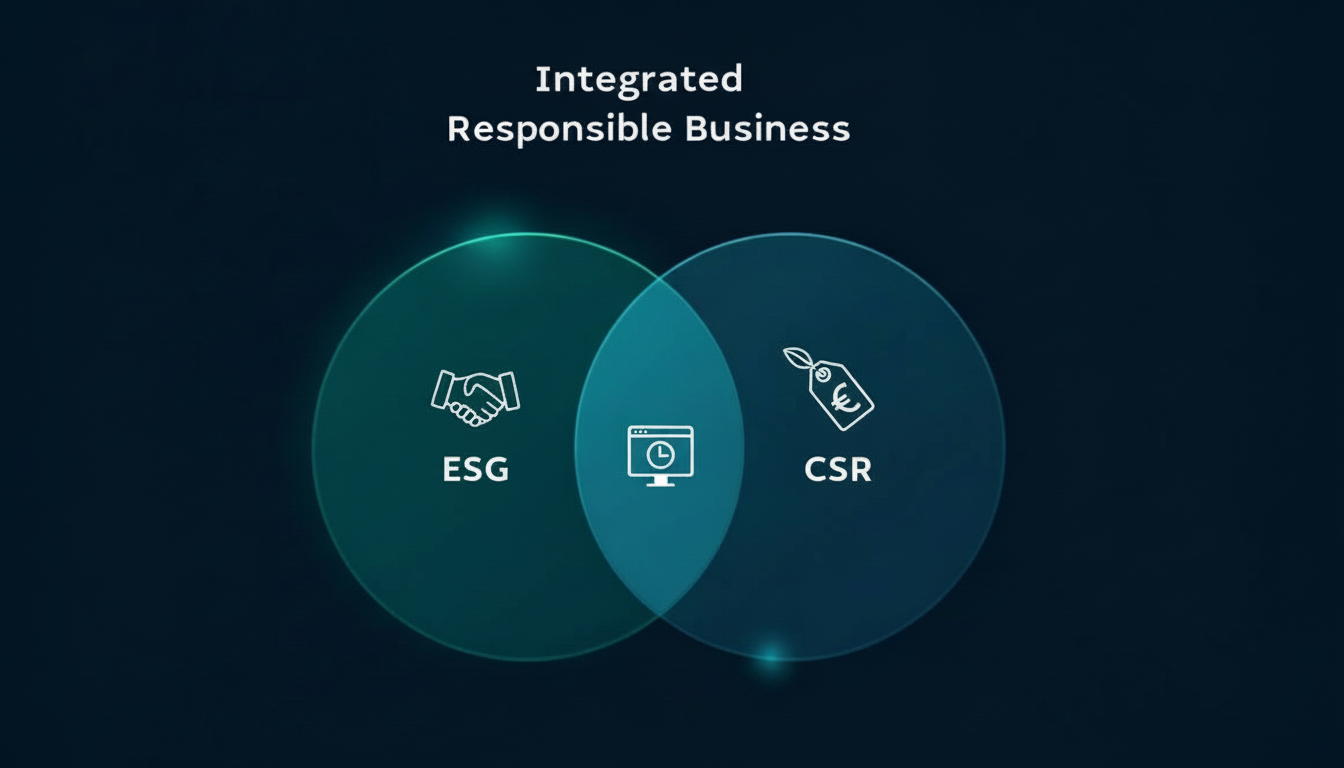
From CSR to ESG: The Evolution of Corporate Responsibility
Corporate Social Responsibility (CSR) traditionally refers to a company's voluntary initiatives to integrate social and environmental concerns into its business strategy and operations. CSR emerged in the late 20th century as businesses recognized their duty to contribute positively to society – whether by reducing carbon footprints, improving labor practices, philanthropy, or developing eco-friendly products. The ethos of CSR is rooted in moral responsibility: companies committing to "do good" beyond profit, thereby enhancing their brand reputation and stakeholder goodwill.
Environmental, Social, and Governance (ESG), on the other hand, is a more recent framework that measures a company's sustainability performance across concrete criteria. Think of ESG as "CSR raised into a measurable strategy". While CSR asks "How are we being responsible corporate citizens?", ESG asks "Can we prove it, and how does it impact value?" ESG metrics cover environmental impact (e.g. carbon emissions, resource use), social impact (e.g. workforce diversity, community relations), and governance (e.g. ethics, board accountability).
Crucially, ESG has reframed corporate responsibility from a values-driven discourse to a value-driven one. As noted in a Berkeley review, ESG evolved the language of CSR "from a values-based discourse, motivated by moral responsibilities, to one that is value-based and aligned with the pursuit of financial performance". ESG integrates sustainability with business value by aligning responsible practices with risk management and long-term financial outcomes.
This evolution was spurred by investor and regulatory forces. Originally promoted by UN initiatives in the mid-2000s, ESG has become mainstream as investors realized that sustainability factors correlate with financial risk and opportunity. Globally, regulations are turning ESG from optional to essential. For instance, the EU is rolling out the Corporate Sustainability Reporting Directive (CSRD) that mandates standardized sustainability reporting even for smaller companies, forcing transparency on ESG performance.
Key difference in summary: CSR is a self-regulated commitment to ethical behavior and social value; ESG is a rigorous assessment and reporting system for those commitments. CSR builds reputation and trust, while ESG provides the metrics and accountability to sustain that trust. In short, CSR is about principles and policies; ESG is about performance and proof.
Why Bridging ESG and CSR Is Essential
Bridging CSR and ESG means aligning a company's ethical intentions with measurable outcomes, creating a unified sustainability strategy. This integration is increasingly seen not as a "nice-to-have" but as a business imperative.
- From Ad-Hoc to Strategic: Many early CSR efforts were well-intentioned but ad-hoc – siloed charity projects or isolated "green" initiatives. By aligning CSR initiatives with ESG goals, companies transform these isolated acts into systemic, strategic endeavors. ESG frameworks help prioritize which CSR activities matter most, ensuring resources target areas of real impact and relevance to stakeholders.
- Accountability and Transparency: Bridging CSR with ESG injects data and accountability into corporate responsibility. Companies that once touted feel-good projects must now "walk the talk" with evidence. This reduces the risk of greenwashing – misleading claims of sustainability. ESG reporting forces a company to measure outcomes, publish progress (and shortfalls), and set clear targets, making ethical commitments credible.
- Stakeholder Trust and Reputation: Stakeholder capitalism is on the rise, meaning companies are judged by how they serve not just shareholders but employees, communities, and the environment. A bridged ESG-CSR strategy addresses both moral expectations and information needs of stakeholders. It demonstrates that the company's social-environmental initiatives are not mere PR, but are core to how the business is run and evaluated.
- Regulatory and Market Pressure: Governments and financial markets are increasingly penalizing unsustainable practices. By bridging to ESG, companies future-proof themselves against tightening regulations. In the EU, new rules like CSRD are expanding sustainability reporting obligations widely.
- Performance and Innovation: What gets measured gets managed. ESG's quantitative approach can drive better performance on sustainability targets – energy efficiency, waste reduction, talent diversity – which often correlates with operational efficiency and innovation.
In summary, bridging ESG and CSR creates a virtuous cycle: ethical commitments inform corporate strategy, and rigorous measurement ensures those commitments deliver tangible results.
Industry 5.0: A Human-Centric Innovation Framework
While companies integrate ESG and CSR, they are also navigating the shift from Industry 4.0 to Industry 5.0. Understanding Industry 5.0 is crucial, as it provides a framework that naturally supports the ESG-CSR bridge by emphasizing human and environmental dimensions of innovation.
Industry 4.0 (the fourth industrial revolution) was characterized by digitization, automation, AI, and the interconnection of machines – "smart factories" focusing on efficiency and productivity. Industry 5.0, a concept championed by the European Commission and thought leaders, complements and extends Industry 4.0 by adding a crucial emphasis on sustainability, resilience, and human-centricity.
Key principles of Industry 5.0 include:
- Human-Centricity: Technology and automation are designed to empower workers, not replace them. In an Industry 5.0 factory, human creativity and expertise work in tandem with robots and AI. This places employees' safety, growth, and well-being at the center of industrial strategy.
- Sustainability: Industry 5.0 holds that industrial development must respect planetary boundaries. It extends the Industry 4.0 focus on efficiency to include environmental sustainability – for example, using renewable energy-powered production systems to cut carbon emissions.
- Resilience: The COVID-19 pandemic and global supply chain disruptions have highlighted the need for resilient industries. Industry 5.0 promotes resilience by diversifying supply chains, adopting flexible production, and integrating risk management into design.
In essence, Industry 5.0 is about "harmonizing the interactions between people, machines and the environment", going beyond operational efficiency to achieve broader societal value.
Converging ESG/CSR with Industry 5.0: Technology with Purpose
Industry 5.0 provides an ideal context for bridging ESG and CSR, because it encourages companies to embed purpose and sustainability into the core of technological innovation.
- ESG as a Non-Negotiable in Innovation: As businesses adopt cutting-edge tech like AI, Internet of Things (IoT), robotics, and digital twins, Industry 5.0 insists that these innovations be deployed in ways that advance ESG objectives. Meeting ESG standards is becoming a non-negotiable requirement across global markets.
- Innovation Driven by Stakeholder Needs: In the Industry 5.0 era, stakeholder-centric design becomes a mantra. Products and services are developed with consideration of customer well-being, community impact, and alignment to global challenges.
- Governance and Ethics in Tech Deployment: Governance (the "G" in ESG) takes on new importance as advanced tech raises ethical questions (e.g. AI bias, data privacy, bioethics). Industry 5.0's human-centric stance implies strong ethical governance frameworks around technology.
- Reskilling and Empowering Workforce: A human-centric approach means heavy investments in employee development and well-being. As automation expands, companies practicing Industry 5.0 are retraining workers for higher-skilled roles.
- Sustainable Value Chains: Industry 5.0 thinking extends beyond the factory walls to the entire value chain, leveraging technology to improve sustainability end-to-end.
Frameworks and Strategies for Sustainable, Human-Centric Business
To operationalize the bridge between ESG and CSR within an Industry 5.0 context, companies can adopt several frameworks and strategies:
- Stakeholder Value Model: Redefine the business's purpose around stakeholder outcomes, not just shareholder profit. Embracing models like the Triple Bottom Line (People, Planet, Profit) ensures that decisions are filtered through a wider moral lens.
- Integrated ESG Management and Reporting: Develop a robust system for ESG data collection, monitoring, and reporting that ties directly into CSR objectives. Many companies use frameworks like the Global Reporting Initiative (GRI) or Sustainability Accounting Standards Board (SASB).
- Strategic Alignment with Global Goals: Align the company's CSR/ESG strategy with external frameworks such as the United Nations Sustainable Development Goals (SDGs). Mapping corporate initiatives to relevant SDGs provides a holistic vision of impact.
- Innovation for Sustainability: Treat sustainability challenges as opportunities for innovation – a concept at the heart of Industry 5.0. Companies should establish innovation programs focused on ESG goals, encouraging R&D in areas like green technology.
- Capacity Building and Culture: A company can't excel in ESG or Industry 5.0 without the right culture and capabilities. Training and empowering employees at all levels on sustainability and innovation is a strategic priority.
- Continuous Monitoring and Adaptation: Adopt an iterative, adaptive approach to their ESG-CSR strategy. Establish feedback loops: monitor performance data, solicit stakeholder feedback, publish results, and be willing to adapt.
Nordic and EU Leadership: A Regional Blueprint
For companies in the Nordics and the broader EU, the convergence of ESG, CSR, and Industry 5.0 is not a distant ideal but an active pursuit. These regions offer a kind of blueprint for others to follow.
The Nordic countries (Sweden, Denmark, Norway, Finland, Iceland) consistently rank at the top of global sustainability and ESG indices. This is partly due to national policies that emphasize welfare, education, and environmental protection – fertile ground for CSR values. In 2024, Finland, Norway, and Sweden held the top three spots in one major country sustainability ranking.
The European Union amplifies these tendencies with a strong regulatory push. Aside from CSRD, the EU's Green Deal and related policies are nudging companies to funnel capital into sustainable projects and disclose climate risks.
For firms in other regions, the Nordic/EU experience underscores an important lesson: embedding ESG and CSR into an innovation-driven strategy is a source of competitive advantage, not a cost.
Conclusion: Toward a Moral and Sustainable Business Future
We stand at a crossroads where business morality and business strategy are becoming one and the same. Bridging ESG with CSR is the mechanism by which companies can ensure that doing good for society also means doing well competitively.
The rise of Industry 5.0 amplifies this imperative. It provides a vision of enterprise where innovation is not divorced from humanity, but rather driven by it.
For business leaders, the path forward is clear. Strengthen your CSR initiatives by making them data-driven and outcome-focused under ESG frameworks. Leverage the momentum of Industry 5.0 to adopt technologies that serve sustainability and people, not just efficiency. Cultivate a corporate culture that prizes transparency, inclusiveness, and long-term thinking.
In closing, bridging ESG and CSR is about engineering a new kind of corporate excellence – one measured not only by profit margins, but by the positive impact on people's lives and the planet's future. It is the cornerstone of enhanced business morality and sustainability. Companies that embrace this bridge will likely be the trailblazers of the next economy, proving that profit and purpose can not only coexist but mutually reinforce each other.
Sources
- European Commission, Industry 5.0: Towards a sustainable, human-centric and resilient European industry, 2021
- Electronics Sourcing, Industry 5.0: Shaping trends in 2025, April 2025
- Worldfavor Sustainability Blog, ESG vs CSR: what is the difference?, 2023
- Seneca ESG Insights, Aligning CSR Policy with ESG Goals: A Comprehensive Guide, Oct 2023
- California Management Review, ESG and the Changing Language of CSR, Feb 2025
- Robeco, Nordic nations sweep top spots in sustainability ranking, June 2024
- Additional supporting data from ScienceDirect on Industry 5.0, ESG, and SDGs