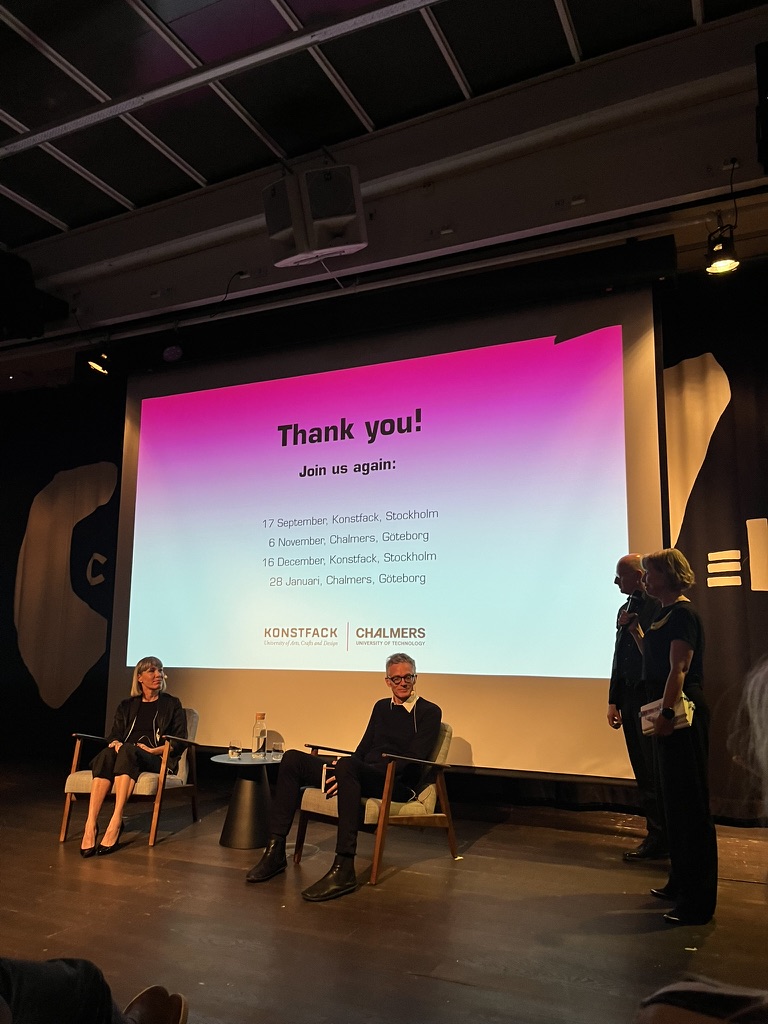
I went for Jamer Hunt.
Possible Futures is a new dialogue series from Konstfack and Chalmers, alternating between Stockholm and Gothenburg. The premiere put Hunt — Vice Provost for Transdisciplinary Initiatives at The New School, and founding director of the Transdisciplinary Design programme at Parsons — in conversation with Darja Isaksson, Director General of Vinnova. Free entry, full house, an hour, dinner afterwards.
I expected a lecture and got something smaller and better made. It also felt like a warm-up: the question got opened and then the hour ran out. For a premiere that may be the right call. But it means the most interesting thing said all evening was left standing where it was.
The room, and the thing he didn't say
Hunt made an observation about experience that he declined to open.
The substance was roughly this: a room fills with physical objects, and that arrangement of things constitutes an experience — one we need, and that isn't optional. He said it plainly and then moved on, and what stayed with me was the implication underneath rather than the claim itself. He seemed to be suggesting that experience is something other than the objects, without going anywhere near what that something is.
My reading of the unfinished thought
I think the gesture was about scale, and I think it comes from the same place his book does.
Not to Scale argues that we reason well at some magnitudes and catastrophically badly at others. The paradox at its centre is that more information has made us less capable rather than more: the global consequences of ordinary choices stay unimaginable no matter how much data we're handed, and problems above a certain size stop being thinkable at all.
Put that next to the room, and the unfinished sentence finishes itself.
Experience is scale-bound. The room full of objects is precisely the magnitude at which human perception still works — a scale you can stand inside, where the objects are present at once and the whole thing resolves without translation. Step above it and experience stops being available as a category. You cannot experience a supply chain. You cannot experience a climate system, a procurement framework, or a five-billion-euro fund. You can only ever be shown a representation and asked to feel something appropriate about it.
Which means the honest version of the claim is harder than it sounds. Experience isn't a quality you add to large systems. It's a thing that only exists small, and everything above that size is representation wearing experience's clothes.
Why this lands hard for me
I've been arguing for something I call an experience layer — the idea that Europe's opportunity in AI-native commerce sits above the models and infrastructure, in the layer where human-centred values are defaults rather than retrofits.
If Hunt is right, that thesis has a problem at its centre, and I'd rather name it than route around it. A layer is by definition a system-scale object. Experience, on his account, is a room-scale phenomenon. Calling something an experience layer might be exactly the category error he spent a book describing — the small word borrowed to make the large thing feel comprehensible.
I don't think it collapses the argument. I think it sharpens what the work actually is: not designing experience at system scale, which may be impossible, but designing the passage between the two — the mechanisms by which something room-sized stays intact as it becomes large, and something large becomes small enough to be entered.
That is a more difficult brief than the one I had walking in. It's also a better one.
The pairing
The other thing worth noticing was structural, and I suspect deliberate.
Hunt studies why humans can't reason at large magnitudes. Isaksson runs the agency that has to allocate at exactly those magnitudes — national innovation policy, where every decision is made about a scale nobody in the room can picture. Putting those two in conversation is a good piece of programming. Whether the conversation reached the collision between them, I'm not sure it did. The hour went elsewhere.
Note to self
I left before the dinner.
The talk was what I came for, so I treated the evening as complete once I had it, shook a hand, and walked out into a free drink I didn't take.
That was a mistake, and a familiar one. The formal hour is the pretext. The informal hour is where the translation actually happens — one person explaining their work to another, adjusting in real time until it lands, at exactly the room scale where experience is still possible.
I had just spent an hour thinking about why things fall apart above room scale, and then I walked out of the room.
Possible Futures continues: 17 September at Konstfack, Stockholm · 6 November at Chalmers, Göteborg · 16 December at Konstfack, Stockholm · 28 January at Chalmers, Göteborg.
Jamer Hunt, Not to Scale: How the Small Becomes Large, the Large Becomes Unthinkable, and the Unthinkable Becomes Possible (2020).